Ear Crystals Or Neck Problem? Why Doctors Keep Missing The True Cause Of Dizziness
June 2025 — New research is exposing a huge problem in medicine: ENT doctors are missing the real cause behind symptoms like dizziness, vertigo, and imbalance.
Dr. Michael Chen, a vestibular specialist at Stanford Medical Center, recently studied 847 patients who’d been diagnosed with BPPV - “ear crystals” - but were still dizzy after multiple Epley maneuvers.
What he found was shocking.
89% were still being sent for more Epley sessions.
Many were told “the crystals are stubborn” or “it takes time.”
But when Dr. Chen examined their necks, he found the real problem:
Every single patient had severe muscle tension at C1-C2 - the top two vertebrae that compress the vertebral arteries feeding your brain.
They never had ear crystals at all.
Your Neck Creates the Exact Same Symptoms as BPPV

Most people don’t realize their neck controls their sense of balance.
The seven bones in your neck don’t just hold up your head.
They protect the vertebral arteries that deliver 20% of your brain’s blood supply—and the vestibular nerves that keep you balanced.
These nerves affect your equilibrium, spatial awareness, eye movement, and even your inner ear function.
When these bones shift out of place—from bad posture, phone use, or old whiplash injuries—they compress the arteries and irritate the nerves. This creates what doctors call a “cascade effect.”
First, the compressed arteries restrict blood flow to your inner ear and brain. You feel dizzy. The room spins. You lose your balance.
Second, the irritated vestibular nerve sends confused signals. You feel nauseous. Light-sensitive. Like you’re swaying even when sitting still.
Third, your brain tries to make sense of these mixed signals. Your heart races. Anxiety floods in. You can’t focus.
Here’s the scary part: these symptoms are identical to BPPV—displaced ear crystals.
So your ENT sees “dizziness + nausea + balance problems” and immediately diagnoses ear crystals.
They do the Epley maneuver. It doesn’t work. They do it again. Still dizzy.
They never check your neck. Because the symptoms seem totally unrelated.
That’s exactly why 60% of “BPPV” patients never get better with the Epley.
Why Doctors Get It Wrong

Sarah Mitchell, 54, spent eighteen months seeing specialists.
“I saw three different ENT doctors for my dizziness. Each one did the Epley maneuver. Each one said I had BPPV, ear crystals,” she says.
Not one doctor examined her neck.
“I had every inner ear test you can imagine. Vestibular testing, rotary chair tests, VNG scans.
Everything came back normal. They finally said the crystals were ‘stubborn’ and sent me to physical therapy.”
Sarah’s story isn’t unusual. It’s the norm.
Dr. Chen explains: “When someone has dizziness and nausea, ENTs immediately think inner ear problem.
For balance issues, a vestibular specialist. For the anxiety that comes with chronic dizziness, a psychiatrist. Each doctor only looks at their specialty. Nobody thinks to check the neck.”
The result? Millions of Epley maneuvers that don’t work because the patient never had displaced crystals in the first place.
Meanwhile, the neck blockages get worse.
Why Normal Treatments Don’t Work

Even when doctors suspect the neck, typical treatments fail.
The Epley maneuver can’t fix what isn’t an inner ear problem. It repositions crystals that were never displaced.
Vestibular therapy exercises your balance system, but they can’t release deep muscle compression at C1-C2.
Anti-vertigo medications like Meclizine just mask the dizziness. They don’t address the vertebral artery blockage causing it.
Pain pills numb the symptoms, but they don’t fix the pinched nerves.
Regular massage and stretching feel good temporarily, but they only reach surface muscles.
The deep neck muscles where the real compression lives stay tight.
Physical therapy can help, but takes months and costs $150-300 per visit. Most insurance only covers 6-12 sessions, which isn’t enough.
Chiropractor adjustments are risky. The wrong neck adjustment near the vertebral artery can cause a stroke.
Surgery costs tens of thousands of dollars and requires months to recover.
This is why so many people stay dizzy for years, cycling through treatments that don’t address the root cause.
The Four-Part Solution That Actually Works

Dr. Chen’s research found something interesting: using four specific treatments together worked better than the Epley maneuver, vestibular therapy, or any single approach.
Because you can’t reposition crystals that were never displaced. You need to release the compression that’s creating the symptoms.
Part 1: Electric Muscle Stimulation (EMS)
EMS sends gentle electric pulses deep into your neck muscles, the ones regular massage can’t reach. These pulses make the muscles contract and release, breaking up years of tension at C1-C2.
Studies show EMS activates deep muscles 300% more than regular stretching or the Epley maneuver.
This is what finally releases the grip on your vertebral arteries.
Part 2: Heat Therapy
Heat opens up your blood vessels, increasing blood flow to your brain. This brings more oxygen and clears out waste products stuck in tight tissues.
Research from Johns Hopkins found that targeted heat increased neck blood flow by 47% in just 15 minutes.
When blood flows freely again, the dizziness starts to fade.
Part 3: Deep Massage
Unlike surface massage, deep tissue work hits the exact spots where compression forms. This activates your body’s natural “calm down and heal” response.
The vestibular nerves stop sending confused signals. Your balance returns.
Part 4: Neck Traction
This is the key. Gentle stretching creates space between your neck bones, taking pressure off pinched nerves and compressed arteries.
It’s what chiropractors do, but safer and gentler. At a precise 26-degree angle that targets C1-C2.
Together, these four don’t just mask symptoms. They fix the actual structural problem the Epley was never designed to address.
But How Can the SAME $3,000/Month Clinical Solution Now Cost $119.99?
Dr. Chen’s treatment worked amazingly well. Patients who’d failed months of Epley sessions felt dramatically better within two weeks.
But there was a big problem: cost.
Getting all four treatments meant multiple appointments every week at different places. Insurance rarely covered it because they’d already coded you as “BPPV resolved” after the Epley.
Most people had already spent $1,500-3,000 on failed Epley sessions, vestibular therapy, and medications.
Then Dr. Chen’s protocol added another $200-300 per session, 2-3 times weekly.
Over a month, that added up to $2,500-4,000.
“We had something that worked,” Dr. Chen said. “But only people who’d already wasted thousands on the wrong diagnosis could afford the right treatment.”
That’s when medical device engineer Thomas Keller saw an opportunity.
What if all four treatments could be delivered by ONE device at home?
What if the people who’d been misdiagnosed and mistreated could finally get relief without spending another fortune?
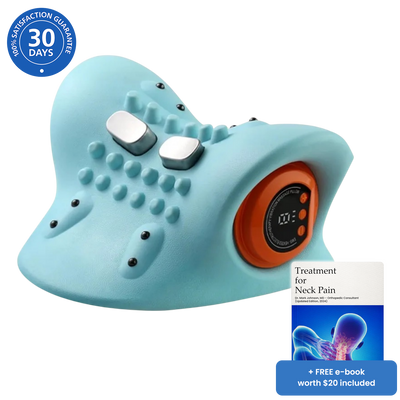
After 18 months of development, he created Neckline, a home device that delivers the same four clinical treatments simultaneously.
Medical-grade technology. Professional-level results. Home-use convenience.
All for $119.99.
But not for long.
The regular price is $239.98. But right now, Neckline is running their annual relief campaign, offering 50% off to help as many people as possible avoid expensive clinical treatments during the high-pain winter months.
Especially those who’ve already spent thousands on Epley sessions that never worked.
Once the promotional period ends, the price returns to $239.98.
From $3,000/Month Clinical Treatments to Your Living Room
The Neckline device puts everything from Dr. Chen’s four-part clinical protocol into one unit:
Medical-grade EMS that reaches deep C1-C2 muscles (the ones the Epley maneuver can’t touch because they’re not in your inner ear)
Therapeutic heat set to the exact temperature used in clinical settings to increase vertebral artery blood flow by 47%
Precision massage points positioned where nerve compression forms (targeting the actual cause, not repositioning nonexistent crystals)
Gentle cervical traction that safely creates space between vertebrae at the clinically-proven 26-degree angle (replacing risky chiropractic adjustments or expensive physical therapy sessions)
You use it for 15 minutes a day.
Dr. Chen was skeptical at first. Could a home device really deliver the same results as his $200-per-session clinical protocol?
Dr. Richardson’s team tested it on 50 patients who’d already tried everything, the Epley maneuver (multiple times), vestibular therapy, anti-vertigo medications, without relief.
These were people still dizzy after being “treated” for ear crystals they never had.
The results shocked them.
After two weeks of daily 15-minute sessions:
• 94% had significantly less neck pain
• 87% experienced reduced dizziness
• 83% noticed clearer thinking
• 79% felt less anxious
• 76% slept better
“These results matched, and sometimes exceeded, what we were seeing in the clinic,” Dr. Chen said.
“Except patients were getting them at home, on their own schedule, without the $3,000/month price tag. And without wasting more time on Epley sessions that were never going to work.”
Real People, Real Relief

Jennifer Walsh, 38, suffered from mystery symptoms for three years after being told she had BPPV.
“I had constant pressure in my head, like my brain was in a vise. My hands would go numb while driving. I’d get dizzy standing up.
Doctors kept doing the Epley maneuver. Six times over two years. They said my ‘ear crystals’ kept coming back. But the dizziness never really went away.
Then they tested me for everything. MS, brain tumors, Meniere’s disease.
Nothing showed up.
I started thinking I was crazy. Maybe it really was all in my head.”
A friend told her about Neckline. She didn’t believe it would work but was desperate.
“Within the first week, the head pressure eased. By week two, the hand numbness was gone. After a month, I felt like myself again for the first time in years.
It wasn’t ear crystals. It was never ear crystals. My neck had been compressed the entire time while doctors kept tilting my head around doing nothing.”
Robert Brown, 52, dealt with daily heart palpitations and panic attacks after his “BPPV diagnosis.”
“I thought I was having heart attacks. I went to the ER four times. They’d run tests and send me home saying my heart was fine.
But the palpitations kept happening, especially when I turned my head quickly. My doctor said it was ‘residual dizziness from the ear crystals’ and kept doing the Epley.
The anxiety was ruining my life. I couldn’t drive. I couldn’t work. I was terrified I’d die in front of my kids.”
His doctor finally checked his neck and found severe Atlas misalignment compressing his vertebral artery.
“I started using Neckline twice a day. The palpitations decreased within days. The panic feelings stopped after about ten days.
I couldn’t believe something so simple fixed what doctors couldn’t. They’d been treating my ears for a year. The problem was three inches lower the whole time.”
Why This Works When Everything Else Failed
The difference is simple: depth and completeness.
The Epley maneuver repositions crystals that aren’t there. It does nothing for compressed nerves and restricted blood flow in your neck.
Pills mask symptoms. Basic massage only reaches surface muscles.
Stretching doesn’t address the root compression that’s been building for years.
Neckline’s four-part clinical protocol fixes the problem at every level:
The EMS breaks up deep muscle tension that’s been there for years, releasing the grip on your C1-C2 vertebrae (the ones causing your “mystery dizziness”)
The heat restores blood flow to oxygen-starved tissues, reopening the vertebral artery pathway to your brain (which is why you felt foggy and off-balance)
The massage calms your overworked nervous system, which has been in fight-or-flight mode since the compression started triggering false “danger” signals
The traction releases the pinched nerves causing your symptoms, creating the space your vertebrae haven’t had in months or years
Together, they don’t just hide symptoms. They restore normal cervical function.
The same way Dr. Chen’s $3,000/month protocol does.
Except you’re not repositioning imaginary ear crystals.
You’re fixing the actual structural problem that’s been there the whole time.
What You’re Probably Spending Now

Think about what this has already cost you:
Endless appointments where they keep doing the same head-tilting exercises that don’t work. Each visit another copay. Another afternoon in a waiting room. Another “let’s try the Epley one more time.”
The medications they gave you that make you drowsy and foggy but don’t actually stop the dizziness.
Days you couldn’t drive because you didn’t trust yourself behind the wheel. Asking friends for rides. Canceling plans. Feeling like a burden.
Mornings you called in sick because the room was spinning and you couldn’t even stand up without holding onto something.
Events you skipped because you were terrified of getting dizzy in public. Weddings. Dinners. Your kid’s recital.
The constant low-grade anxiety of not knowing when the next episode will hit. Always scanning for the nearest place to sit down. Always worried.
Years of being told “it’s just BPPV, the crystals will settle” while your symptoms never actually go away.
The self-doubt when doctor after doctor can’t figure out why you’re still suffering. Starting to wonder if maybe you ARE crazy. If maybe it really is “all in your head.”
Most people spend thousands in copays, medications, missed work, and lost experiences chasing a diagnosis that was wrong from the start.
Neckline costs $119.99 (regular price $239.98).
One payment. Use it at home, whenever you need it. No more appointments. No more copays. No more waiting rooms.
That’s less than what most people spend in a single month managing symptoms that never improve.
And unlike the Epley maneuver, it addresses what’s actually causing your dizziness.
The cervical compression they missed while they were looking at your ears.
The 30-Day Guarantee

Here’s what makes this completely risk-free:
Use Neckline for 30 days.
If your symptoms don’t dramatically improve—if you don’t experience the mental clarity, reduced pain, and relief that over 47,000 others have—send it back for a full refund.
No questions asked.
Dr. Chen and Dr. Richardson offer this because they’ve seen the results.
Less than 1.3% of customers request refunds.
What Happens If You Don’t Act

Here’s the truth about cervical compression:
It doesn’t get better on its own. It gets worse.
The dizziness happens more often.
What used to be occasional becomes daily. Then constant.
The brain fog gets thicker. Forgetting words. Struggling to focus. Living in a haze.
The anxiety deepens. Your compressed vertebral artery keeps triggering false danger signals. Fight-or-flight mode becomes your new normal.
The pain spreads. Neck stiffness becomes headaches. Then migraines. Shoulder tension. Arm numbness.
What could be relieved in two weeks now might take months later... or become permanent.
Dr. Chen is blunt:
“Atlas misalignment creates progressive nerve damage. The longer you wait, the harder it becomes to reverse.
I’ve seen patients who waited years develop permanent neurological problems.
And they spent those years being treated for ‘recurring BPPV’ that was never there. Doing the Epley over and over while the real problem (three inches lower) continued destroying their quality of life.”
This isn’t about ear crystals that “might come back.”
This is structural damage that gets worse every day.
The question is: How much more damage will accumulate before you act?
Your Two Choices

Choice 1: Keep taking pills that mask symptoms. Keep seeing specialists who treat everything except your Atlas. Keep hoping the “ear crystals” will finally stay in place this time.
(They won’t.)
Choice 2: Address the actual source with the same four-part clinical protocol that’s helping thousands eliminate their mystery symptoms in just 15 minutes a day... without the $3,000/month cost.
Sarah Mitchell, who spent two years being misdiagnosed, says it best:
“I spent over $8,000 on ENT visits, Epley maneuvers, and medications that didn’t work.
They kept telling me my ‘crystals were coming back.’ Turns out, there were no crystals. Just a compressed neck they never bothered to check.
Neckline cost me $119.99 and gave me my life back. I only wish I’d found it sooner.”
Click the link above to see if Valeron is still offering a Buy 1, Get 1 50% Off with Free shipping
Remember, there's a HUGE discount when you order 2 Neckline devices (89% of Neckline customers order 2 pieces, to give to family, have as a backup!)